
South Africa’s pleasant year-round weather makes it a welcome home to many local and international cycling enthusiasts. The sport’s growing popularity has been linked to increased health awareness, convenient access and increasing interest in outdoor activities – drawing both casual and competitive cyclists of all ages to the sport.

As one of the most energy-efficient modes of land-based travel in the animal kingdom, cycling forms a vital part of both transport and recreation.
Outside of accidental injuries, crashes and collisions, cycling is widely viewed as a low-impact sport. However, like all repetitive forms of movement, cycling can have high biomechanical demands and has been found to place heavy demands on the musculoskeletal system – particularly the spine and large joints.
Understanding Joint Loading in Cycling
Joints are designed to move while bearing load. During cycling, many joints work within a relatively limited range of movement, but do so repeatedly over a prolonged timeframe.
The three points of contact with the bicycle are the pelvis (in the saddle), hands/forearms (on handlebars) and feet (on the pedals). These parts of the body, under sustained loading/repetitive movement/incorrect positioning can cause muscle fatigue, gradual strain, increased pressure and compression of the underlying or adjacent structures.
The key factors influencing joint loading in cycling include:
- Repetition: Thousands of pedal cycles during a single ride
- Sustained posture: Limited variation in joint position
- Weight distribution: Particularly through the upper limbs
- Muscle endurance: Fatigue and muscle imbalances may alter joint mechanics over time
Unlike acute injuries caused by falls or collisions, many cycling-related joint issues develop gradually.
Neck and Shoulder Joint Strain in Cycling
When cycling, the cervical spine (the neck) is in extension, and the thoracic spine (torso) is in flexion. The posture of the head is forward of the shoulders. This increases stress on the cervical spine and surrounding muscles. The prolonged stress causes pain colloquially known as ‘cyclists’ neck’ – exaggerated by increased loading of the upper limbs.
Although cycling is primarily a lower-limb activity, the shoulders and elbows play an important stabilising role. Despite moving less than other joints, they are exposed to continuous load and act as part of the shock-absorbing chain between the handlebars and the shoulders. These large joints support the upper body and help maintain balance and control.
Ideally only 40% total body weight should be transmitted through the upper limbs. Factors that increase weightbearing through the upper limbs during cycling include:
- Dropped handlebars
- An elevated saddle
- A bike that is too long for the rider
- A heavy helmet
- Improper helmet wear (too low in front)
- Poorly fitting glasses
- High tyre pressure/rough terrain etc.
South African cyclists may also present with pain over the right shoulder (due to looking out for passing traffic). This repetitive action is associated with paraspinal pain, neck pain, headaches, tightness between the shoulder blades and based of skull pain.
Thoracic outlet syndrome (TOS) may also cause neck (as well as shoulder/arm) pain. The symptoms would include weakness/pins and needles in the arm/hand, occipital headaches and cold/blue hands). In South Africa, TOS is managed primarily by cardiothoracic surgeons and Dr Maina would ensure appropriate referral after ruling out other potential orthopaedic causes for your symptoms.

Awareness of shoulder symptoms is particularly relevant for longer rides or endurance cycling. Persistent or worsening symptoms should not be ignored and medical attention should be sought to avoid irreparable damage to the structures of the shoulder.
Other Upper Limb Considerations

During a ride, the wrist is held in fixed extension.
Long-duration/distance cycling on both mountain and road bikes can transfer excessive pressure through the hands. Vibrations from the road or trails may also compress nerves and blood vessels in the wrist and hand, causing ‘cyclists’ palsy’.
Long-duration/distance cycling on both mountain and road bikes can transfer excessive pressure through the hands. Vibrations from the road or trails may also compress nerves and blood vessels in the wrist and hand, causing ‘cyclists’ palsy’.
Other factors that may increase pressure across the wrist include:
- Downhill cycling
- Weak or inefficient core muscles
- Equipment issues related to:
- Incorrect saddle/handlebar height
- Incorrect wheels/tyres (small diameter, skinny, overinflated, etc)
- Worn-out/ill-fitting gloves
- Fixed hand position
- Inappropriate shape/size of the handlebars resulting in increased hand vibrations
‘Cyclists palsy’ may be diagnosed following a combination of either one or both of
- Ulnar nerve compression (affecting the pinky and ring finger) due to compression at Guyon’s canal in the base of the hand, resulting in numbness, tingling, weakness, clumsiness, cramping and pain.
- Median nerve compression (affecting the thumb, index and middle fingers) resulting in carpal tunnel syndrome (CTS). Untreated, CTS leads to permanent nerve damage: pins and needles with wasting and weakness of hand muscles.
Other predisposing factors to consider include: previous wrist and hand injuries, age-related degenerative changes, prior use of a crutch, etc.
Knee Joint Stress in Cyclists
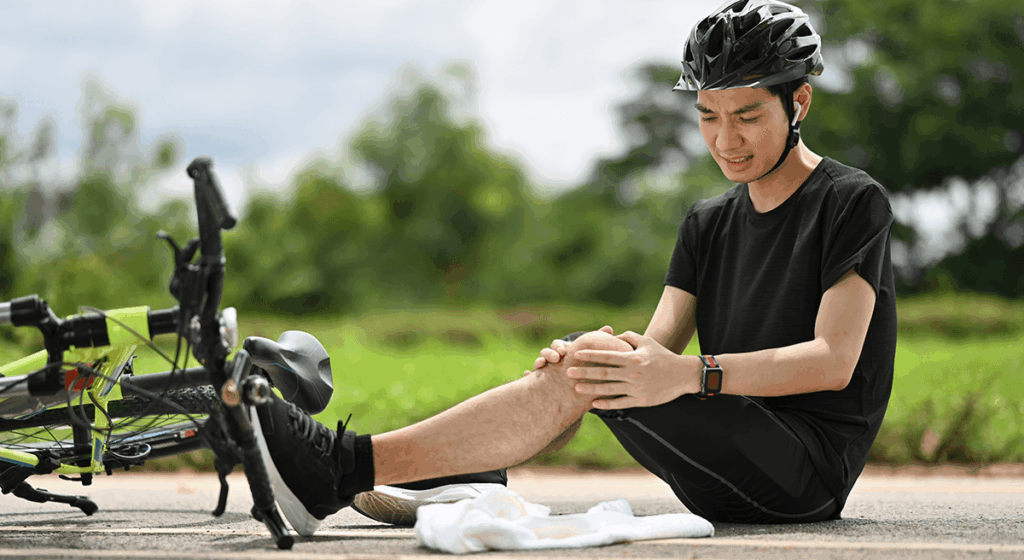
‘Cyclists knee’ is the second most reported overuse injury in cycling – due to its role in repetitive pedalling – and has a reported incidence of between 36% – 62%.
During cycling, the knee:
- Moves through a consistent, repetitive arc
- Transfers force between the hip and the lower leg
- Relies on surrounding muscles and structures for stability
Due to the recurrent movement, a problem in the lower kinematic chain (core, lumbar spine, hip, knee and ankle) knee biomechanics can be altered, resulting in knee pain.
Anterior (front) knee pain may be experienced as medial (inside joint) or lateral (outside joint) symptoms and/or stiffness during or after activity as a result of the increased patellofemoral (i.e. between the kneecap and thigh bone) pressure.
‘Cyclists knee’ is often associated with:
- Riding at a slow cadence
- Incorrect cleat alignment –this increases twisting of the tibia which in turn increases patellofemoral pressures. Lateral or medial knee pain can be due to the toe pointing too far in. or outward, respectively.
- Incorrect cleat position (foot too far forward on the pedal) can result in posterior knee pain by tightening the tensor fascia lata, biceps femoris, hip abductors etc [outside of the knee] – or tight adductors, hamstrings, glutes [inside of the knee])
- Incorrect saddle height (knee pain is inversely related to saddle height – i.e. a low saddle causes more pain)
- Incorrect saddle position (placed too far forward)
- Tight calf/hamstrings/glutes
- Weak or inadequate core/pelvic muscles to stabilize the pelvis impairing lower limb kinetic chain function.
While many knee symptoms are mild and transient, do contact your healthcare provider or Dr Maina’s rooms to assess symptoms of ongoing discomfort.
Back Discomfort in Cycling
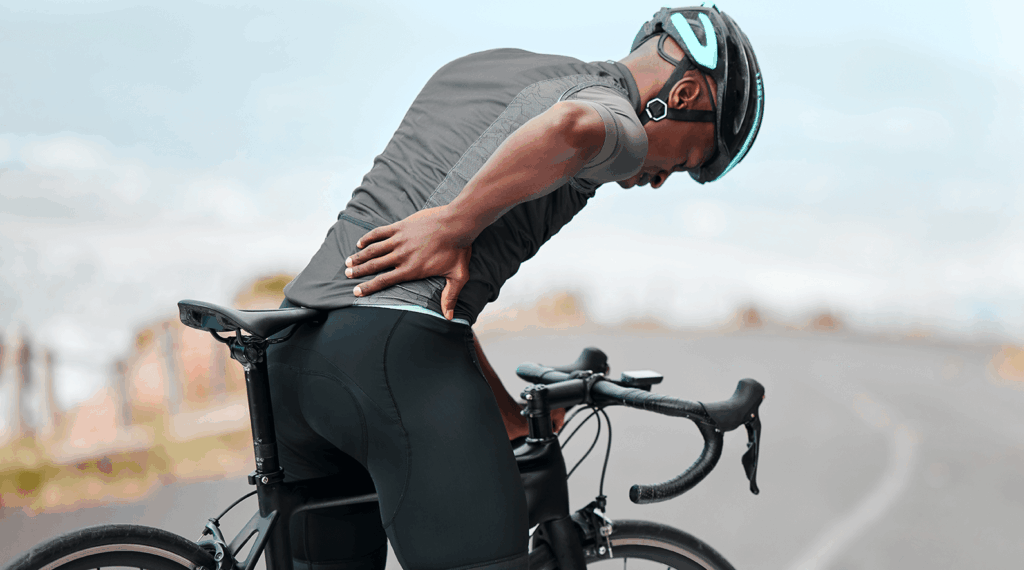
Low back pain (LBP) is one of the commonest adult musculoskeletal complaints. LBP is defined as pain located below the ribs and above the pelvis. This pain may/may not radiate to the legs.
LBP in general is prevalent in sports that involve predominantly seated postures like cycling, rowing etc with lifetime prevalence rates in cycling as high as 94%.
‘Cyclists back’ may arise from:
- The hunched over position of a road cyclist
- An uneven saddle
- Raised saddle height causing increased pelvic tilting due to decreased knee flexion (<25%) at the end of the stroke which results in increased strain in low back muscles.
- Handlebars too far forward causing overstretching of the back
- Excessive hip flexion causing low back flexion and decreasing core abdominal muscle support
- Selecting high gears at a slow cadence increases low back muscle strain – the ideal cadence is 90 RPM.
- Tight hamstrings pulling on the pelvis causing a flexed pelvis.
- Weak core muscles increaseing back strain.
- Cyclists travelling >160km per week are nearly four times more likely to report low back pain
Additional risk factors for LBP include younger cyclists and cyclists with a high body mass.
The type of cycling also has a direct impact on the incidence of LBP. Mountain biking has a more upright sitting position, time trials require a streamlined and deeply flexed hip with forearms on trial bars and road cycling sits between the two. The more aggressive the sitting posture, the higher the incidence of symptoms.
Conclusion: Promoting Joint Awareness and Safe Participation
Cycling remains a valuable form of physical activity for many people. Developing an awareness of how joints respond to cycling allows the rider to avoid injury and make the most of their recreational and training time.
Using a professional bike fitting service helps customise equipment to help avoid injuries, improve ergonomics and biomechanics while optimising performance and comfort – regardless of cycling discipline.
Low-impact sports like cycling still require whole-body athletic flexibility, mobility and strengthening. It is important to be aware of one’s level of fitness, as this helps with the avoidance of injuries due to fatigue and poor posture. Paired with an appropriate training intensity/volume, one can reasonably reduce the risk of injury and prolong pain-free participation and enjoyment in cycling.

This article aimed to provide general educational information about how cycling can affect certain joints — especially the shoulders, elbows, spine, hips, and knees — to support public understanding and awareness. It does not provide or replace a professional assessment by a healthcare provider.
Dr Anne Maina
Specialist Orthopaedic surgeon
MBBCh (Wits), FC Orth (SA), MMed Ortho (Wits)
References:
- Pernambuco AP, Santos IA, do Amaral LF, Sousa MV, de Melo Passos AB, Vieira GC, de Morais MR, Leal JC. Cycling and low back pain: A large cross-sectional study on prevalence and risk factors. Journal of Bodywork and Movement Therapies. 2025 Aug 14.
- Cyclist’s Knee [Internet]. United Kingdom. Physiopedia. C2026. Courses. 2022. [Cited 13th FEB 2026]. Available from: https://www.physio-pedia.com/Cyclist%27s_Knee

